Tell us about the job
Takes about a minute. No obligation.
Electricity heats more occupied homes in Tillamook County, Oregon than any other fuel, at 78.6% (2020-2024 ACS 5-year). Electric water heaters put the entire heating load on the elements and the thermostats, with no burner, no flue, and no combustion air path to share or absorb any of it. When a unit in this county fails, a contractor pulls the access panels and tests the elements for continuity before looking at anything else, because that is where the resistance to ground, the scale buildup, and the burnout show up. Sediment from the local water supply insulates the lower element over time, forcing it to run hotter and longer to hit the set point, which is what pushes it past its rated life.
Pipes and wiring in a house are rarely swapped out when a water heater is replaced, which means the infrastructure a contractor opens up to has often been in place through several generations of equipment. Half the homes in Tillamook County, Oregon were built in 1980 or earlier (2020-2024 ACS 5-year). That history matters for repair work: a contractor pulling a failed component checks whether the supply lines, the venting path, and the electrical connection serving the unit were built for what is actually there now, or were adapted to it over time. What those connections look like once accessed determines whether the repair is a straightforward part swap or whether something behind the wall has been quietly contributing to the failure.
The Parts of a Water Heater a Contractor Checks During a Repair
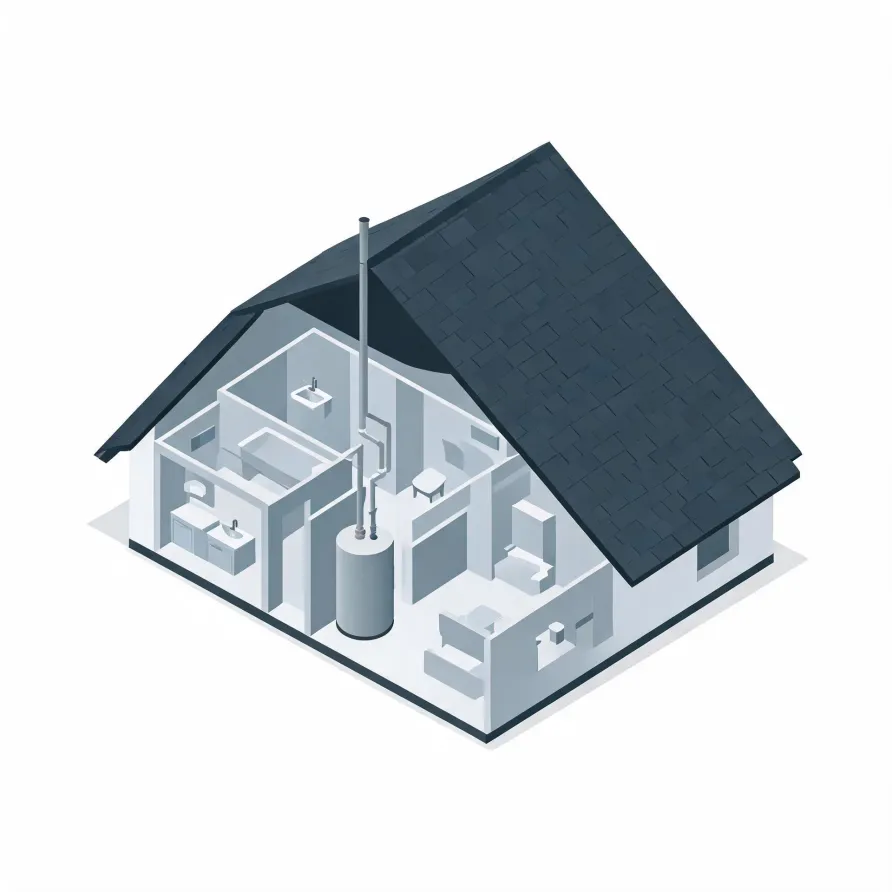
The tank is the center of the system, sitting in a utility space, garage, or closet, and its job is to hold and heat a reserve of water. The burner or heating element at the bottom of the tank is where most repairs begin, since it is what actually raises the water temperature. The thermostat mounted on the tank controls when that element fires.
The pressure relief valve sits on the side of the tank and releases if internal pressure climbs too high. The anode rod runs down through the tank and slows corrosion from the inside. Inlet and outlet pipes connect the tank to the home's cold supply and the hot water lines running to fixtures throughout the house.
The drawing shows a general layout of these components, and a licensed contractor determines what applies to the specific unit and setup in your home.
Get matched in Tillamook CountyTillamook County, by the numbers
10 severe weather events were recorded in Tillamook County, Oregon between 2015 and 2024.
NOAA National Centers for Environmental Information, Storm Events Database, bulk CSV export, events 2015-01-01 through 2024-12-31.Half the homes in Tillamook County, Oregon were built in 1980 or earlier (2020-2024 ACS 5-year).
U.S. Census Bureau, 2020-2024 American Community Survey 5-Year EstimatesTillamook County, Oregon holds 19,213 housing units (2020-2024 ACS 5-year).
U.S. Census Bureau, 2020-2024 American Community Survey 5-Year EstimatesOwners occupy 74.3% of the occupied homes in Tillamook County, Oregon (2020-2024 ACS 5-year).
U.S. Census Bureau, 2020-2024 American Community Survey 5-Year EstimatesCodes & Standards for Water Heater Repair in Tillamook County, Oregon2 sourced rules & standards
Licensing and Legal Requirements in Tillamook County, Oregon
Oregon’s contractor licence does not reach casual, minor or inconsequential work on one structure where the person’s contracts total less than $1,000 — and the exemption is unavailable to anyone who advertises or signs themselves as a contractor, at any price.
Oregon requires a current Construction Contractors Board licence, with the right endorsement, to undertake, offer to undertake or bid construction work.