Tell us about the job
Takes about a minute. No obligation.
Electric water heaters run on a different failure pattern than gas units, and what a contractor checks first depends on what the home actually burns. Electricity heats more occupied homes in Josephine County, Oregon than any other fuel, at 56.2% (2020-2024 ACS 5-year). In an electric tank, resistance heating elements and their thermostats cycle every time hot water is drawn, and those cycles accumulate wear in a way that combustion-based systems do not replicate. When a unit stops producing hot water or recovers slowly, the element is the first thing a contractor tests, not the gas valve or the pilot assembly that simply does not exist here. Sediment buildup accelerates element failure by forcing the element to heat through an insulating layer at the bottom of the tank, so a contractor also checks for that during the same visit.
Older plumbing configurations and venting arrangements are what a repair contractor runs into once the panels come off or the access door opens. Half the homes in Josephine County, Oregon were built in 1982 or earlier (2020-2024 ACS 5-year). A house built to those standards was plumbed and vented for equipment that has since been swapped out, sometimes more than once, and each swap leaves its own layer of adaptation behind. When a part fails, what the contractor actually bills for is shaped as much by what those earlier adaptations left in the wall as by the failed component itself.
The Parts of a Water Heater a Contractor Checks During Repair
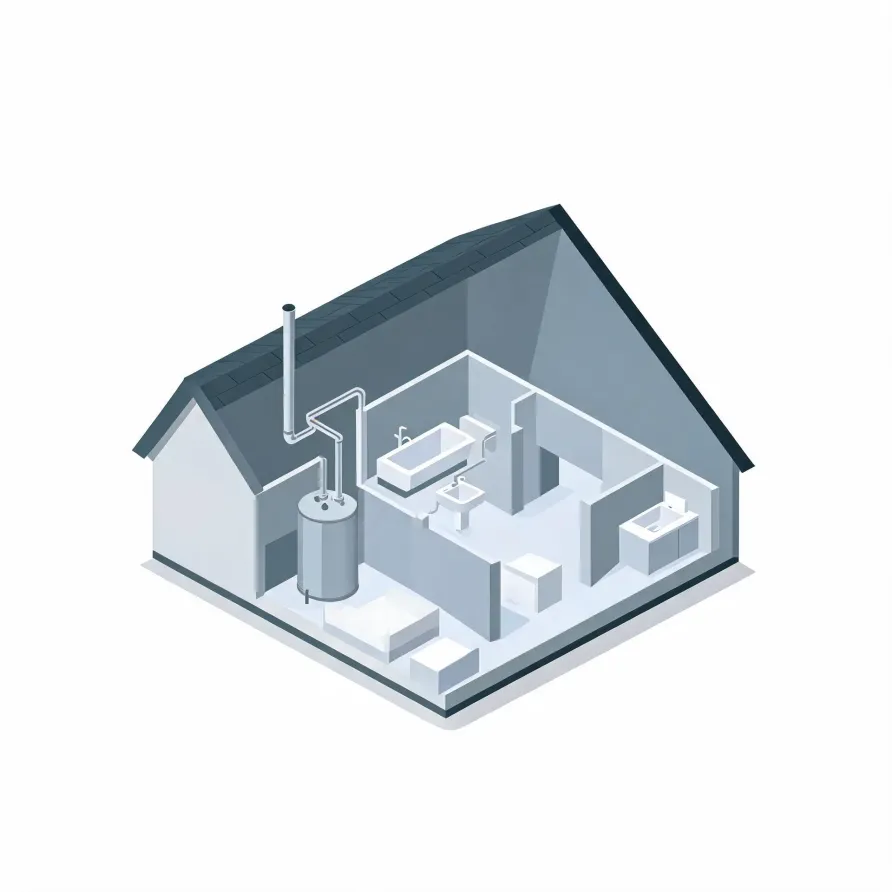
The tank is the center of the system, sitting in a utility space, basement, or closet, and its job is to hold and heat a supply of water on demand. The burner assembly or heating element sits at the base or inside the tank and is where a contractor looks first when the water runs cold or the unit stops responding.
The thermostat controls the target temperature and is mounted directly on the unit. The pressure relief valve sits on the tank's side or top and opens if pressure builds beyond a safe point. The anode rod runs inside the tank and slows corrosion from within, and a failed rod often explains why older tanks begin to degrade.
The drawing shows a general layout of these components, and a licensed contractor determines which of them apply to the specific unit and installation in your home.
Get matched in Josephine CountyJosephine County, by the record
91 severe weather events were recorded in Josephine County, Oregon between 2015 and 2024.
NOAA National Centers for Environmental Information, Storm Events Database, bulk CSV export, events 2015-01-01 through 2024-12-31.Half the homes in Josephine County, Oregon were built in 1982 or earlier (2020-2024 ACS 5-year).
U.S. Census Bureau, 2020-2024 American Community Survey 5-Year EstimatesJosephine County, Oregon holds 39,503 housing units (2020-2024 ACS 5-year).
U.S. Census Bureau, 2020-2024 American Community Survey 5-Year EstimatesOwners occupy 71.7% of the occupied homes in Josephine County, Oregon (2020-2024 ACS 5-year).
U.S. Census Bureau, 2020-2024 American Community Survey 5-Year EstimatesCodes & Standards Behind Water Heater Repair in Josephine County, Oregon2 sourced rules and standards
Licensing and Legal Requirements in Josephine County, Oregon
Oregon’s contractor licence does not reach casual, minor or inconsequential work on one structure where the person’s contracts total less than $1,000 — and the exemption is unavailable to anyone who advertises or signs themselves as a contractor, at any price.
Oregon requires a current Construction Contractors Board licence, with the right endorsement, to undertake, offer to undertake or bid construction work.
Severe Weather Events in Josephine County
Extreme weather puts a measurable load on water heaters, forcing them to work harder and recover more slowly after each event. How much of that pressure your equipment faces depends on what the local pattern actually looks like.
91 severe weather events, 2015–2024. Source: NOAA National Centers for Environmental Information, Storm Events Database.